

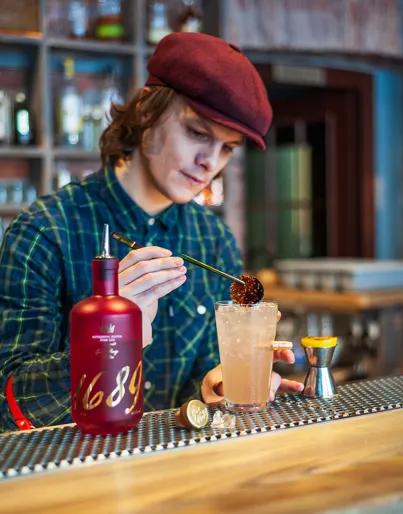
Gin 1689 is a Dutch spirits company based in Amsterdam that has become widely known for reviving one of the earliest recorded gin recipes from the seventeenth century. The company has built its reputation on a balance between heritage and modern craftsmanship, taking a historical recipe from the age of William of Orange and bringing it into today’s premium gin market. Its main products, 1689 Dutch Dry Gin and 1689 Dutch Pink Gin, are now sold in more than thirty countries across four continents and have received recognition from leading spirits organizations around the world. The success of Gin 1689 is closely tied to its unique story, one that reaches back more than three centuries to a period when gin was first introduced to the wider public of England and quickly became a cultural phenomenon.
The company’s identity is rooted in the events of 1689, the year William of Orange ascended to the throne of Great Britain. William brought with him a Dutch spirit known as jenever (considered the father of gin), which soon spread in popularity across London. This marked the beginning of a shift in English drinking culture and led to what historians later described as the gin craze, a time when gin overtook beer as one of the most widely consumed beverages in the country. That moment in history laid the foundation for Gin 1689’s name and its mission to connect the modern gin drinker to the spirit’s origins.
The journey of the brand began in 2016 when two friends from Amsterdam, Alexander Janssens and Patrick van der Peet, were living in London. Fascinated by the history of gin and inspired by the story of William of Orange, they decided to research how the spirit first spread from the Netherlands to England. Their curiosity took them to the British Library, one of the largest archives of historical documents in the world. In the library’s rare books section, they uncovered a seventeenth-century distillers’ written by the Worshipful Company of Distillers. The manual included one of the earliest known gin recipes. While it listed all the botanicals, the quantities were recorded in a coded system that was designed to keep the formula secret from members of the guild.
Deciphering this centuries-old code was not a simple task. Janssens and van der Peet worked with historians, distillers, and spirits experts for months, comparing known proportions of other spirits of the same period and conducting small test distillations. The process took months of research and experimentation before they were confident that they had unlocked the original formula. They collaborated with one of the country’s oldest distilleries. This distillery had generations of knowledge in both genever and gin making and was the perfect partner to bring the recipe back to life. Together, they worked to recreate the gin as faithfully as possible while maintaining the quality required for a premium modern product.
In 2018, their work resulted in the launch of 1689 Dutch Dry Gin. Marketed as a revival of the gin that had once traveled from the Netherlands to England, the product offered consumers an opportunity to taste a recipe that had been hidden in archives for centuries. In the next year, the company introduced 1689 Dutch Pink Gin, which was based on the same recipe but with the addition of strawberries and raspberries for natural flavoring. This version gave the spirit a fruit-forward character while keeping the balance of juniper and spice from the original formula. The Pink Gin quickly became a refreshing option for consumers who wanted a lighter twist on tradition.
The flagship 1689 Dutch Dry Gin is distilled with juniper and an array of botanicals that include red quince, apple, lemon peel, orange peel, nutmeg, aniseed, and clove. It is described as a smooth gin that combines herbal, citrus, and spice notes, making it suitable for both classic cocktails and the traditional gin and tonic. The Dutch Pink Gin carries the same base but adds strawberries and raspberries, offering a naturally sweet profile that appeals to a wide range of drinkers.
From its first launch, Gin 1689 gained recognition not only for its story but also for the quality of its products. In 2018, it won a Gold Medal at the Gin Masters in London in the super premium category. Since then, it has earned more than twelve international medals in various spirits competitions. In 2019, the Craft Gin Club in the United Kingdom, one of the largest subscription clubs for gin enthusiasts, selected 1689 Dutch Dry Gin as its Gin of the Month. The selection was made from more than four hundred entries and provided the brand with a valuable introduction to a wide audience of gin lovers.
The company’s growth has been steady and strategic. Following its launch in the Netherlands and the United Kingdom, Gin 1689 expanded into other European countries. By 2019, it had already entered multiple markets, and within just five years, distribution had extended to more than thirty countries across four continents. The brand has reached as far as South Korea and Mexico, in addition to a strong presence in Germany and the United Kingdom. By 2023, Gin 1689 reported total sales of more than one hundred thousand bottles since its launch. In 2024, the company secured a major milestone with its first listing in travel retail, making its products available at Schiphol Amsterdam Airport Duty Free. This achievement underscored the company’s ability to transition from independent shops and regional retailers to international platforms.
The story of Gin 1689 is as much about heritage as it is about modern entrepreneurship. By drawing on a recipe from the seventeenth century, the brand has managed to position itself as a bridge between the past and present. Its founders did not simply create another craft gin but rather reintroduced a spirit that had played a role in one of the most transformative moments in the history of spirits in Europe. At the same time, they adapted the recipe to the expectations of today’s consumers, who demand both authenticity and premium quality. This combination of history, craftsmanship, and international ambition has allowed Gin 1689 to stand out in a crowded spirits market.
More than three centuries after William of Orange carried jenever from the Netherlands to England, Gin 1689 has revived the story in a way that connects directly with modern drinkers. The brand has not only reintroduced an early gin recipe but also transformed it into a successful business that represents Dutch heritage on the global stage. Its rise from an archival discovery in the British Library to an award-winning international label shows how history can inspire innovation and how tradition can be transformed into contemporary success. Gin 1689 continues to grow with a clear identity that honors the legacy of William of Orange’s spirit revolution while ensuring that a centuries-old recipe remains relevant in today’s world.